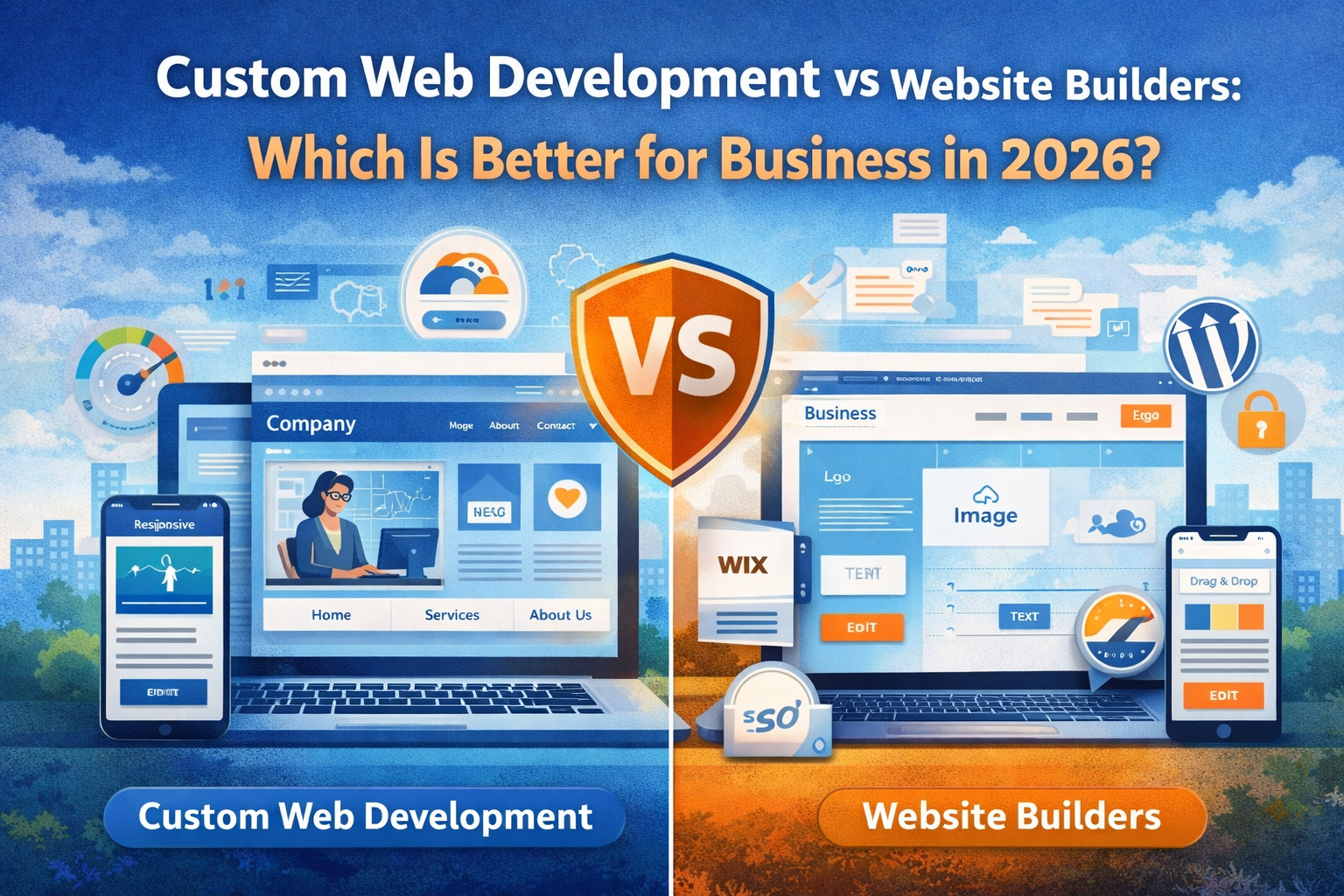
In 2026, every serious business needs a strong online presence. But when it comes to building a website, most business owners face one major question:
Should I use a website builder like WordPress, Wix, or Shopify — or invest in custom web development?
The answer depends on your long-term goals, scalability needs, performance expectations, and brand positioning.
In this guide, we will break down the differences between custom web development and website builders, so you can make the right decision for your business.
What Is Custom Web Development?
Custom web development means building a website from scratch using programming languages such as:
HTML5
CSS3
JavaScript
React / Next.js
PHP / Laravel
Node.js
Custom backend architecture
Instead of using pre-built templates, developers create:
Unique UI/UX design
Custom database structure
Optimized codebase
Scalable backend systems
Advanced functionality
Custom websites are built specifically for your business model, target audience, and operational workflow.
What Are Website Builders?
Website builders are platforms that allow users to create websites using drag-and-drop tools. Popular examples include:
WordPress (with themes)
Wix
Shopify
Squarespace
They offer:
Pre-designed templates
Plugin-based functionality
Quick setup
Lower initial cost
They are suitable for simple websites with standard needs.
Key Differences: Custom Website vs Website Builder
1. Performance & Speed
Custom-built websites are optimized for:
Fast loading speed
Clean code structure
Minimal unnecessary scripts
Better Core Web Vitals
Custom-built websites are optimized for performance metrics aligned with Google’s Core Web Vitals guidelines, which directly impact search rankings and user experience.
Website builders often include:
Heavy themes
Multiple unused plugins
Shared hosting limitations
Page speed directly impacts:
SEO rankings
Conversion rate
User experience
Google prioritizes fast, optimized websites in search results.
2. SEO & Search Engine Optimization
Custom web development gives full control over:
Technical SEO
Schema markup
URL structure
Clean HTML
Server configuration
Structured data
Website builders limit:
Backend optimization
Advanced SEO customization
Code-level improvements
If your goal is long-term organic traffic and ranking on Google, custom development provides stronger SEO flexibility.
3. Scalability & Future Growth
This is where many businesses make mistakes.
A small eCommerce store today may grow into:
Multi-vendor marketplace
International shipping platform
Advanced inventory system
ERP integration
Custom payment gateway
Custom web applications are built to scale.
Website builders may struggle with:
High traffic
Complex workflows
Custom integrations
Advanced security needs
Scalability is critical for serious businesses.
4. Security & Data Protection
Custom websites offer:
Custom authentication systems
Secure API integration
Advanced encryption
Reduced plugin vulnerabilities
Website builders rely heavily on:
Third-party plugins
Shared infrastructure
Publicly known template structures
For eCommerce businesses handling payment data, security is non-negotiable.
5. Branding & Unique Identity
Templates limit creativity.
Thousands of businesses may use the same theme.
Custom web design ensures:
Unique visual identity
Brand-focused UI/UX
Tailored user journey
Conversion-focused layout
Your website should look like your brand — not like a template.
When Should You Choose a Website Builder?
A website builder may be suitable if:
You need a simple portfolio site
Budget is extremely limited
You don’t require advanced functionality
You need a quick temporary solution
It works for freelancers, early startups, or MVP validation.
When Should You Choose Custom Web Development?
Custom web development is ideal if:
You run a growing eCommerce business
You need custom features
You require high security
You plan long-term scaling
You want strong SEO performance
You want complete ownership and control
For serious brands, custom development is a strategic investment.
Cost Comparison: Short-Term vs Long-Term
Website builders appear cheaper initially.
But consider:
Monthly subscription fees
Plugin costs
Transaction fees
Performance limitations
Redesign costs later
Custom web development has:
Higher initial investment
Lower long-term dependency
Better ROI over time
Think long-term, not just launch cost.
AI, Automation & Modern Web Architecture
In 2026, modern websites integrate:
AI chatbots
Automated workflows
CRM systems
Marketing automation
Custom dashboards
API integrations
Custom web applications allow seamless integration with:
Payment gateways
Logistics systems
Inventory management
Analytics platforms
Website builders often restrict deep automation capabilities.
Quick Summary: Custom vs Builder
Choose Website Builder If:
You need a basic site
Budget is very limited
No custom features required
Choose Custom Development If:
You want long-term growth
SEO matters seriously
You need unique branding
You require advanced features
Security is critical
Final Verdict
There is no universal answer.
But there is a strategic answer.
If your website is just an online brochure, a builder may work.
If your website is a core business asset — generating leads, processing payments, managing customers — then custom web development is the smarter choice.
Your website is not an expense.
It is digital infrastructure.
In 2026, businesses that invest in scalable, optimized, secure, and conversion-focused web solutions will dominate their industries.
The real question is not:
“Which is cheaper?”
The real question is:
“Which solution supports my business growth for the next 5–10 years?”
Choose wisely.
Ready to Build a Scalable Website?
If your website is more than just an online brochure — if it’s meant to generate leads, process payments, or support business growth — then custom development is the smarter long-term investment.
At Amartable, we build high-performance, SEO-optimized, scalable websites tailored to your business goals — whether it’s eCommerce, portfolio, corporate, or custom web applications.
Let’s build a website that grows with your business.
Contact us today for a free consultation.
Frequently Asked Questions (FAQs)
1. What is the main difference between custom web development and website builders?
Custom web development provides complete control over design, performance, scalability, and technical SEO, while website builders rely on pre-built templates with limited flexibility.
2. Is custom web development better for SEO?
Yes. Custom-built websites allow structured data implementation, clean code architecture, optimized page speed, and advanced technical SEO configurations.
3. When should a business choose a website builder?
Website builders are suitable for startups or small businesses that need a simple website quickly with limited customization and lower initial investment.
4. Is custom web development worth the cost in 2026?
For businesses focused on long-term growth, brand authority, and conversion optimization, custom web development delivers stronger ROI and scalability.